

Ship portraits documented individual ships. They were often commissioned by ship captains and owners. The vessel was the focus and was always identified by name, flag, or a label at the bottom of the painting. Buyers demanded correctly represented rigging, sails, and masts. The accuracy of these details determines the quality of the painting.
Ship portraitists worked in major port cities. Some artists waited on the wharf and tried to sell their skills in portraiture to captains. To make the process faster, some artists pre-painted a background scene and only needed to add the vessel. The painters studied their subjects to ensure their depictions were accurate. Many ship portraitists had sailed on vessels like the ones they painted.
Take a look at the details in this painting of the bark AUGUSTINE KOBBE by Luigi Renault.
(Fine Art Collection, 0000.438.1.)
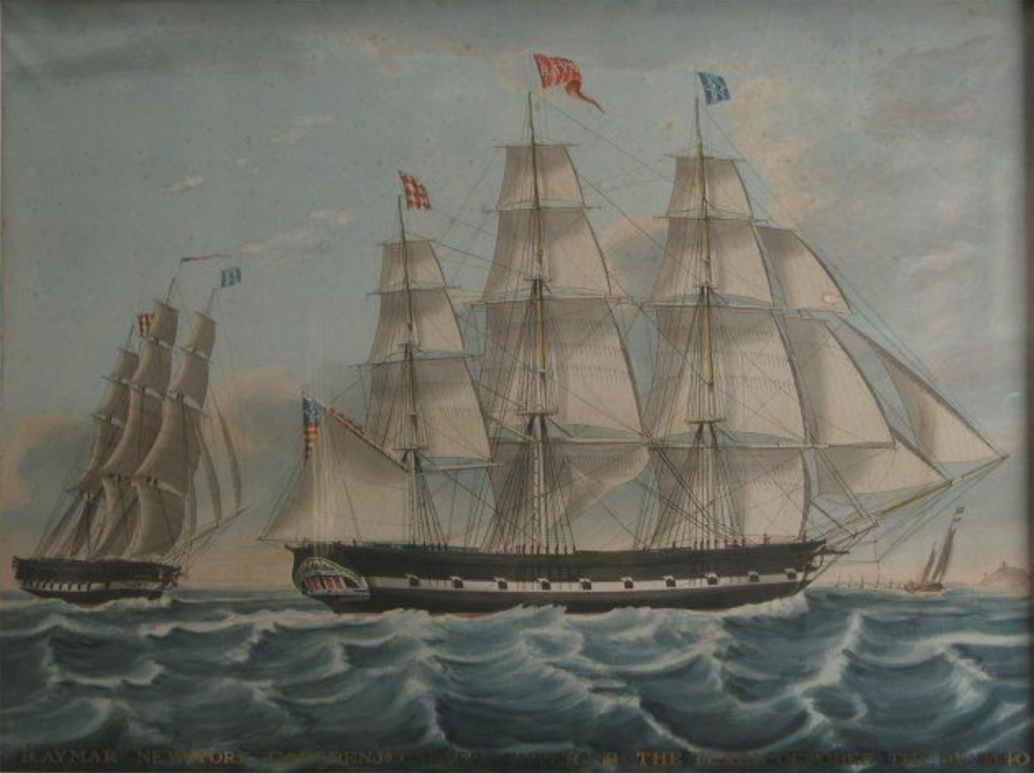
“B. AYMAR New York Capt Benj Carver Entering the Texel October the 16th 1840” by Dirk Anton Teupken. (Carver Collection, 1962.42.1.)
Ship portrait painters did not make much money and often supplemented their income. In the 1850s notable marine artist James Buttersworth sold his paintings for $20 – $50. To support his family of four he needed to sell about 25 works a year.
One technique sometimes used in ship portraiture is to show the vessel in two or three views. The painting to the left shows two views.